


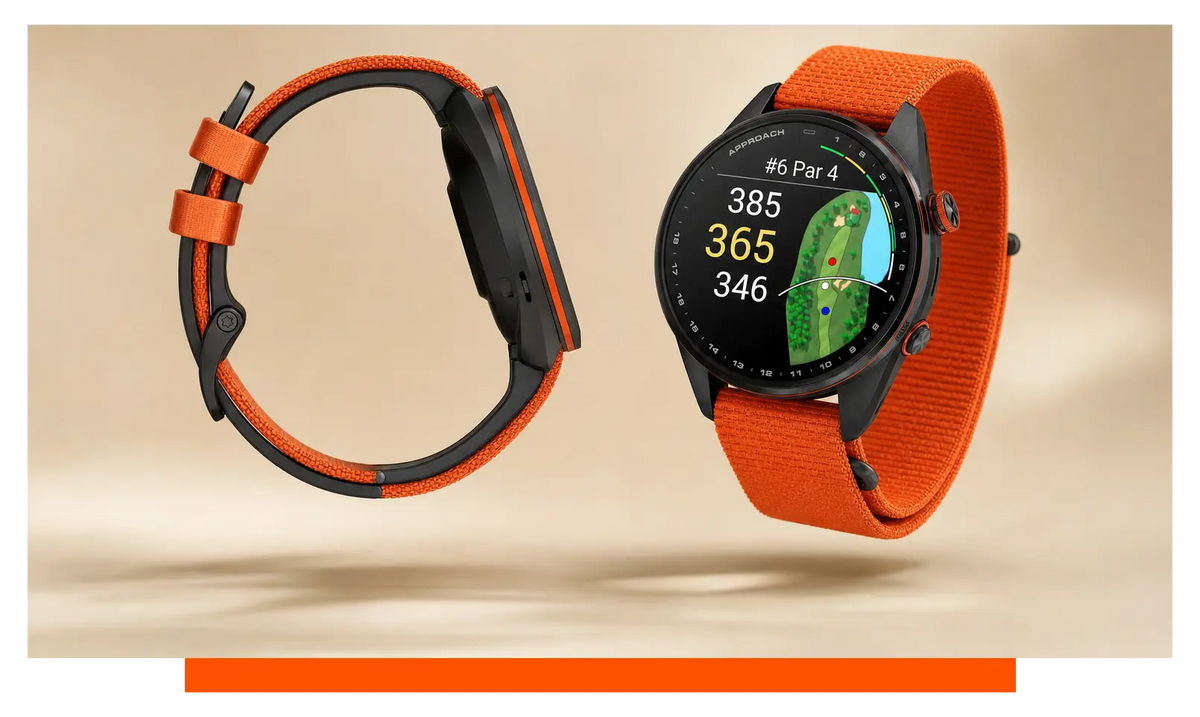
The Garmin Approach S72 is worth it for golfers who will use its swing, practice and post-round analysis. The Garmin Approach S70 is the smarter buy for dependable course maps, distances and caddie guidance, particularly if comfort and strap choice matter. The deciding factor is whether the new data will change how you practise.
The short version
The Approach S72 earns its premium through deeper golf analysis rather than better core distance information.
- Choose the Approach S72 for structured improvement: its swing metrics, driving-range activity, green reading and putting analysis provide more to work with during practice and after a round.
- Keep or choose the Approach S70 for core course use: it already provides CourseView maps, front-middle-back yardages, PlaysLike Distance and Virtual Caddie guidance.
- Do not upgrade for golf battery life: equivalent case sizes carry the same stated golf battery ratings.
- Consider the ongoing membership: Green Reading, Aerial Imagery and Putting Analysis on the S72 require an active Garmin Golf membership.
- Fit may settle it: the smaller S72 is the better shape for a compact wrist, while the lighter S70 and its established strap options remain attractive for long rounds and overnight wear.
- The price gap is substantial: at the time of writing, the Approach S70 starts at £499.99, while either S72 case size costs £699.99.
The trade that matters is simple: the S72 asks you to pay for analysis you can act on, while the S70 concentrates on the course information most golfers use every round.
Garmin Approach S72 vs S70 specifications compared
The specifications show that the S72 changes how deeply you can analyse golf rather than replacing the S70’s established on-course tools.
| Specification | Garmin Approach S70 | Garmin Approach S72 |
|---|---|---|
| Golf analysis tools | Virtual Caddie; PlaysLike Distance; Swing Tempo | Swing Metrics; Green Reading; Putting Analysis |
| Membership requirements | Green Contour data | Green Reading; Aerial Imagery; Putting Analysis |
| Speaker and microphone | No | Yes |
| Case and band weight | 44 g / 56 g | 41 g / 48 g |
| Display size | 1.2" / 1.4" | 1.3" / 1.4" |
| Display resolution | 390 x 390 / 454 x 454 pixels | 416 x 416 / 454 x 454 pixels |
| Golf battery life | Up to 15 / 20 hours | Up to 15 / 20 hours |
| Case sizes | 42 mm / 47 mm | 43 mm / 47 mm |
| Price at the time of writing | £499.99 / £549.99 | £699.99 / £699.99 |
| Preloaded golf courses | 43,000+ | 43,000+ |
| Golf distance tools | F/M/B yardage; PlaysLike Distance | F/M/B yardage; PlaysLike Distance |
| Golf club tracking | Approach CT10 compatible | Approach CT10 compatible |
| Water rating | 5 ATM | 5 ATM |
| Display type | AMOLED | AMOLED |
| GPS | Yes | Yes |
| Health tracking | Yes | Yes |
| Sports tracking | Yes | Yes |
| Smartwatch features | Yes | Yes |
The single deciding trade is still analysis versus value: choose the S72 only when its extra practice and review data will influence what you do next.
Is the Garmin Approach S72 worth upgrading to?
The Approach S72 is worth upgrading to when golf improvement continues after you leave the final green.
Its new tools split into three useful moments. Swing Metrics and the dedicated driving-range activity support deliberate practice. Green Reading and Aerial Imagery can inform a putting line or help you plan a lay-up while playing. Putting Analysis and biometric review give you material to study afterwards.
That is a meaningful package for a golfer who visits the range with a plan, reviews recurring misses and wants evidence rather than memory. Hand speed, backswing length and wrist rotation can give a practice session structure; post-round putting information can then reveal whether the work is transferring to the course.
The upgrade becomes much harder to justify if you normally finish a round, check the score and move on. The S70 already handles the core job well: mapped courses, hazard awareness, adjusted distances and Virtual Caddie guidance. None of those abilities suddenly becomes inadequate because the S72 can collect more information.
On your wrist, the difference is not simply “more golf features”. It is a new routine: practise, collect, review and adjust. If that routine sounds useful, choose the S72. If it sounds like homework, the S70 leaves less valuable data unused.
Membership requirements
The S72’s most distinctive course and review tools are less compelling unless an active Garmin Golf membership suits the way you play.
Green Reading, Aerial Imagery and Putting Analysis sit behind that membership. Green Reading is the in-round feature most likely to affect an immediate decision, while aerial course views help with planning from unfamiliar positions. Putting Analysis earns its keep later, when you are prepared to review patterns instead of relying on the scorecard alone.
The S70 also has a membership-dependent feature in Green Contour data, so subscriptions are not entirely new to the range. The important difference is how much of the S72’s upgrade case rests on membership-only analysis. If those tools are central to your reason for upgrading, their continuing usefulness matters as much as the watch’s purchase price.
Check the courses and data you actually use rather than treating the membership as an automatic extra. A golfer who regularly plays unfamiliar layouts and studies every round may extract real value; someone who mainly wants a quick distance to the green probably will not.
In practice, you will notice the membership most when the premium features become part of your weekly golf habits - not merely icons you opened after buying the watch.
Garmin Approach S72 vs S70: battery life
Golf battery life is not a reason to choose the Approach S72 over the Approach S70.
The smaller S70 and S72 are each rated for up to 15 hours of golf use, while the larger versions are each rated for up to 20 hours. That makes case size more important than generation if you want extra headroom for a long day, a slow competition round or time spent practising before you tee off.
The practical choice is therefore between wrist presence and endurance. A smaller case is easier to sleep in and less likely to interfere with a glove or jacket cuff. A larger case gives you the longer stated golf rating and a roomier map without making you choose one model generation over the other.
Battery estimates still depend on how you use the watch, particularly connected features and screen behaviour, so the ratings are best treated as a case-size comparison. There is no supported advantage here that makes the S72 an automatic upgrade.
What you would actually notice is confidence from choosing the right size for your longest golf day, not a battery breakthrough from moving to the newer watch.
Fit, comfort and straps
The smaller Approach S72 is the neatest fit for compact wrists, but the lighter Approach S70 and its clearly established strap sizing make it an excellent all-day alternative.
The S70 comes in 42 mm and 47 mm cases, weighing 44 g and 56 g with their bands. The S72 shifts the smaller option to 43 mm and weighs 41 g or 48 g, depending on case size. Those differences matter when you wear a golf watch beyond the course: during workouts, under a sleeve and overnight for sleep tracking.
Fitment is particularly straightforward on the S70. Its 42 mm case takes 20 mm straps, while its 47 mm case takes 22 mm straps. That gives you a useful measurement before replacing a band rather than relying on the model name alone. Browse Garmin Approach S70 42mm straps or Garmin Approach S70 47mm straps according to the case on your wrist.
Material choice is broad across every current size here. Silicone, nylon, leather, milanese and metal options are available for both S70 sizes and both S72 sizes. That lets you tune the feel rather than accepting the supplied band as permanent: nylon is a practical way to reduce the rigid feel during a long round, while silicone suits sweat and wet-weather golf. The relevant S72 shelves are Garmin Approach S72 43mm straps and Garmin Approach S72 47mm straps.
If you are weighing golf features against a broader sports watch, our guide to the latest Garmin smartwatches at a glance helps place both Approach models in the wider range.
By bedtime, you are more likely to appreciate a case that sits quietly and a strap that dries quickly than another page of golf data.
Displays, maps and course distances
Both watches deliver the mapped course information serious golfers need, with the S72 making its smaller display a little roomier.
The smaller S70 uses a 1.2-inch AMOLED display at 390 x 390 pixels. The smaller S72 moves to a 1.3-inch AMOLED panel at 416 x 416 pixels. The larger versions match at 1.4 inches and 454 x 454 pixels, so golfers set on the 47 mm case should not expect a display-size advantage from upgrading.
Each watch carries more than 43,000 preloaded courses and provides front, middle and back yardages alongside PlaysLike Distance. That means the basic decision loop is familiar on either model: identify the target, account for the effective distance and use the map to understand hazards or the shape of the hole.
The S72 expands what can be layered onto that foundation through Green Reading and Aerial Imagery, but it does not make the S70’s standard maps and distances suddenly incomplete. If your normal glance is simply “how far is the middle?”, both watches solve it.
The visible gain is clearest on the smaller S72, where the larger, higher-resolution panel gives maps and data a little more breathing room without moving to the biggest case.
Premium materials and storage
The Approach S72 is the more convincing choice if you want premium materials and generous onboard storage in an everyday golf watch.
Garmin equips the S72 with a sapphire crystal and titanium bezel. Sapphire is the feature to value if the watch will be worn daily around golf trolleys, gym equipment, travel and outdoor work, where accidental knocks matter more than they do during a carefully managed round. The titanium bezel supports that premium everyday positioning without forcing you into the heavier model.
The S72 also has 64 GB of storage. That capacity strengthens its role as a watch intended to carry richer mapping and everyday content rather than serving only as a yardage tool. It is not, by itself, a reason to upgrade: spare capacity does not improve a shot unless the features using it matter to you.
This is one place where the decision can flip even for a golfer who is lukewarm about analysis. If you want the toughest premium build for regular wear and tend to keep a watch for a long time, the S72 has a clearer physical appeal.
Day to day, the sapphire face is the part you are most likely to appreciate; the storage remains invisible until your use of maps and content demands it.
Speaker, microphone and everyday features
The S72 is the more capable everyday smartwatch because it adds a speaker and microphone, while the S70 keeps the simpler connected feature set.
That hardware makes the S72 more useful when your watch needs to do more than show a notification. It is a practical distinction for commuters, busy parents and golfers who leave a phone in a bag or trolley, although it has little effect on calculating a lay-up or choosing a club.
Both watches still provide smartwatch features, and both are built to sit at the meeting point between golf, health and daily life. The S70 is therefore not stripped back; it simply lacks the S72’s wrist-based voice hardware.
Think about where you normally keep your phone. If it is always in a pocket, the speaker and microphone may be a convenience rather than a deciding feature. If your handset is regularly out of reach, the newer watch makes more sense as an all-day companion.
Away from the course, this is the S72 difference you are likely to encounter most often because it can help during an ordinary working day, not only after a golf session.
Health and sports tracking
Both watches cover health and sports tracking, so the better fitness choice comes down mainly to fit and the S72’s broader golf-practice role.
You can use either as more than a weekend golf device. Health tracking, sports profiles and GPS are present on both, making them suitable for workouts and everyday activity between rounds. The S72’s dedicated driving-range activity is the significant golfer-specific addition: it treats practice as a session worth recording rather than an informal extension of a round.
For overnight tracking, comfort can outweigh the feature list. The smaller S72 combines the compact case with its ComfortFit fabric band, while an S70 owner can change material and fit using its known strap width. A secure band that does not need overtightening will usually be easier to tolerate through sleep and exercise than a loose, heavier setup.
Neither watch wins simply because it says “health tracking” or “sports tracking” on the specification sheet. Choose around the activities you repeat, the case you can wear continuously and whether range metrics belong in your training plan.
During a mixed week of golf, workouts and sleep tracking, the watch that disappears on your wrist will usually collect the most useful record.
Where the Garmin Approach S70 is better
The Approach S70 is better on value, straightforward on-course use and established strap fitment.
- Lower purchase price: the 42 mm S70 is £499.99 and the 47 mm S70 is £549.99 at the time of writing.
- Core golf tools already covered: Virtual Caddie, PlaysLike Distance, Swing Tempo and more than 43,000 preloaded courses handle the needs of many regular players.
- No battery sacrifice against the matching size: golf ratings are up to 15 hours for the smaller case and up to 20 hours for the larger case.
- Clear replacement-band sizing: the 42 mm case uses 20 mm straps and the 47 mm case uses 22 mm straps.
- Broad material choice: silicone, nylon, leather, milanese and metal straps are available for either S70 case size.
Where the Garmin Approach S72 is better
The Approach S72 is better for deliberate practice, post-round review and premium everyday wear.
- Deeper golf analysis: Swing Metrics, Green Reading and Putting Analysis add information that can shape practice and course decisions.
- Dedicated range work: the driving-range activity records wrist-based swing information and can log the session for later review.
- Premium construction: sapphire crystal and a titanium bezel suit regular all-day use.
- Lighter case-and-band combinations: the stated weights are 41 g and 48 g.
- More capable connected hardware: the built-in speaker and microphone extend its usefulness away from the course.
- More storage: 64 GB supports its richer mapping and everyday-watch role.
Who should choose which
The right choice depends on whether you want a highly capable course companion or a golf-analysis system you will use between rounds.
- Choose the Approach S70 if you mainly want distances, maps and caddie guidance: it performs the central on-course job without making you pay for analysis you may ignore.
- Choose the Approach S70 if comfort and strap flexibility lead the decision: both case sizes have known strap widths and a broad choice of replacement materials.
- Choose the Approach S70 if you already own one and rarely review performance data: the S72’s new insight will not improve your golf merely by being collected.
- Choose the Approach S72 if you practise with specific goals: swing metrics and the range activity can turn a bucket of balls into a recorded session.
- Choose the Approach S72 if you review putting and biometric information after playing: this is where its deeper data has the best chance of changing your next session.
- Choose the smaller S72 if you have a compact wrist: its 43 mm case, 41 g case-and-band weight and ComfortFit fabric band make it the strongest everyday fit here.
- Choose a 47 mm model for maximum stated golf endurance: both generations provide up to 20 hours, so analysis and price can settle the remaining decision.
For most golfers who only need excellent course guidance, the S70 remains the sensible buy; the S72 earns the step up when its new data becomes part of how you improve.
Frequently asked questions
Does the Garmin Approach S72 need CT10 club sensors?
No. Approach CT10 sensors are optional for automatic shot, distance and club tracking; Club Prompt can build the required club history for Virtual Caddie without them.
Does either watch work well with an iPhone?
Yes. Both pair with an iPhone for Garmin Golf connectivity and smart notifications, although S70 users can view text notifications but cannot send text replies from the watch.
Can I answer calls from the Approach S72?
Yes, when it is paired with a compatible smartphone. Its built-in speaker and microphone let you make and take phone calls from your wrist.
Are the S72’s new golf features allowed in competition play?
The S72 is tournament legal with Tournament Mode enabled, but that mode removes Virtual Caddie, PinPointer and PlaysLike Distance. Competition committees may prohibit distance devices, while advice features must not be used during a stipulated round.
Is the Approach S72 better than the Approach S50 for a serious golfer?
Yes, if you want Virtual Caddie, range activity, swing metrics, green reading, aerial imagery and detailed putting analysis. The S50 is the simpler fit when core course information and everyday fitness tracking are enough.
Does the S72 flashlight make a practical difference away from the course?
Yes, when you need to find keys, kit or a path in low light. It provides variable white light and a red light, although using it reduces battery life.


Leave a comment
All comments are moderated before being published.
This site is protected by hCaptcha and the hCaptcha Privacy Policy and Terms of Service apply.