


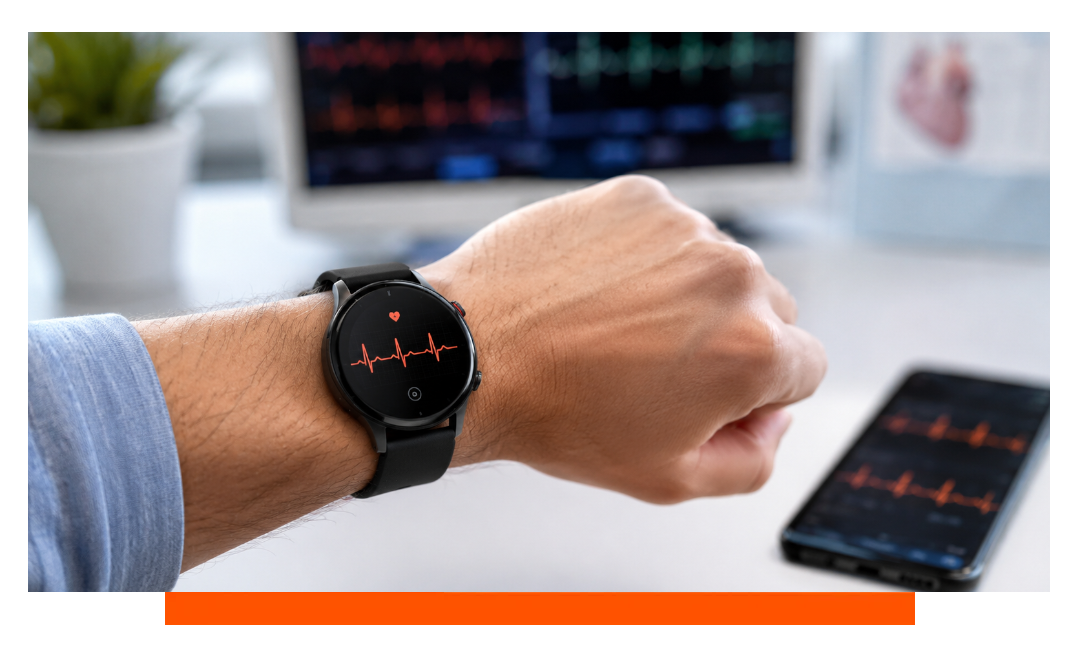
The Samsung Galaxy Watch ECG is highly accurate for screening atrial fibrillation and basic rhythm irregularities when used correctly, but it is not a substitute for a 12-lead clinical ECG or a clinician’s evaluation. Expect strong agreement in calm, seated tests and lower reliability with motion, poor contact, or noise.
What the Galaxy Watch ECG actually measures
The Galaxy Watch 8 records a single-lead rhythm tracing equivalent to Lead I. You place a finger on the side electrode for about 30 seconds while sitting still. The algorithm classifies the tracing as sinus rhythm, atrial fibrillation, inconclusive, or poor recording.
Single-lead ECGs excel at rhythm analysis rather than diagnosing structural heart disease. They capture timing and regularity of beats with millisecond precision. They cannot show the full 3D electrical picture a 12-lead ECG provides.
Lead I perspective and implications
Lead I views electrical activity across the upper chest from right to left. Many common arrhythmias, especially atrial fibrillation, are visible in Lead I. Some localized abnormalities can be missed because they are more apparent in other leads.
How accurate is Galaxy Watch 8 ECG in practice
In controlled, seated measurements, single-lead wearables consistently demonstrate high agreement with medical-grade single-lead equipment for AF screening. Published validations have shown strong concordance and high positive predictive value when recordings are clean. Real-world accuracy primarily depends on user technique and noise control.
Lab-grade conditions vs everyday life
Clinical validations collect 30-second traces while users are still, warm, and relaxed. This minimizes motion artifacts and muscle noise that can confuse algorithms. Everyday recordings may introduce movement, dry skin, or poor contact, reducing classification confidence.
How it compares with a 12-lead ECG
A 12-lead ECG remains the gold standard for diagnosing complex conduction issues, ischemia, and localization. The watch provides a high-quality rhythm snapshot from one angle. For AF screening, single-lead devices can approach clinical performance in ideal conditions, but they cannot replace multi-lead diagnostics.
Quick accuracy snapshot
| Aspect | Galaxy Watch 8 ECG | Clinical 12-lead ECG |
|---|---|---|
| Leads captured | Single-lead, Lead I equivalent | 12 simultaneous leads |
| Recording duration | 30 seconds typical | 10 seconds standard, extendable |
| Primary target | Atrial fibrillation screening | Comprehensive cardiac assessment |
| Best-case agreement | High in seated tests | Reference standard |
| Motion tolerance | Low - artifacts likely | Moderate with filtering |
| User dependence | High - contact and posture | Lower - clinician setup |
| Output | Rhythm classification + PDF | Full diagnostic tracing |
Does Galaxy Watch have medically approved ECG?
Yes, Samsung’s ECG app is cleared in multiple regions, including FDA clearance in the United States and CE marking in the EU. Clearance means it met safety and performance criteria for its intended use. It is a regulated screening tool, not a full diagnostic system.
Availability depends on country, phone compatibility, and the Samsung Health Monitor app. Regional regulatory updates can expand or restrict features. Always check the Samsung Health Monitor compatibility list for your region.
What medical clearance does - and does not - mean
Clearance validates accuracy for rhythm classification under specified conditions. It does not guarantee correct results in every situation. Doctors still interpret clinical significance in context of symptoms, risk factors, and multi-lead testing.
How to use ECG on Samsung watch?
You can record an ECG on the Galaxy Watch 8 in about a minute. For best accuracy, sit still, keep arms rested on a table, and ensure good skin contact. Follow these quick steps.
- Install Samsung Health Monitor
- Open ECG on watch
- Sit and relax
- Rest arm on table
- Touch side electrode
- Hold for 30 seconds
- Review and export PDF
The first setup typically requires a compatible Samsung Galaxy phone. Once configured, you can share the PDF with your clinician. If you see frequent inconclusive results, revisit fit, posture, and contact.
Exporting and sharing results
The app stores tracings and classifications on the phone. You can export a standard PDF that includes the waveform, heart rate, and label. Sharing a clean, symptom-tagged recording helps clinicians evaluate context.
Factors that affect ECG accuracy
Accuracy depends on signal-to-noise ratio during the 30-second capture. Motion, muscle tension, and electrical interference can distort the tracing. Good skin contact and a calm posture matter most.
Fit, strap, and skin contact
A snug, comfortable fit reduces micro-movements that create noise. Clean skin and electrodes improve conductivity, especially in dry or cold environments. Consider breathable, secure bands - for example, explore our Samsung straps to optimize daily fit.
Environment, posture, and habits
Crossed legs, clenched fists, or talking can inject artifacts. Tattoos, heavy lotion, or very dry skin may degrade contact quality. Warm up your hands for 1 to 2 minutes if your fingers are cold.
Optimizing real-world results on Galaxy Watch 8
Repeat a recording if you see an inconclusive or poor signal message. Capture when seated, calm, and after a few deep breaths. Tag recordings with symptoms like palpitations or dizziness for clinical context.
Signal hygiene tips
- Stay fully still
- Rest both arms
- Keep steady contact
- Avoid speaking
- Warm your hands
Keep the watch sensors clean and dry between sessions. Store and charge the device properly to avoid moisture accumulation - useful options sit under Samsung accessories. Replace worn bands that loosen over time.
Interpreting ECG classifications
Sinus rhythm means a regular beat pattern without detected AF. Atrial fibrillation indicates irregular, disorganized atrial activity that warrants medical review, especially with symptoms. Inconclusive often points to noise, ectopic beats, or borderline rates outside classification thresholds.
When to seek medical advice
If you record AF or persistent symptoms like chest pain, shortness of breath, or syncope, contact a clinician. Single-lead tools are best for screening and trend capture, not diagnosis. Bring exported PDFs and symptom notes to your appointment.
Galaxy Watch 8 vs earlier Samsung models
The Galaxy Watch 8 focuses on faster processing and refined algorithms for classification reliability. Improved electrodes and software filtering help reduce motion artifacts when posture is correct. Backward-compatible ECG workflows remain similar to prior Samsung models.
Why algorithm refinements matter
Better filtering preserves true P-QRS-T morphology while reducing noise. More robust rhythm analysis supports clearer AF discrimination in clean traces. This improves confidence for users and clinicians reviewing exported PDFs.
Who benefits most from wearable ECG
Users experiencing intermittent palpitations benefit from on-demand capture. Those with known paroxysmal AF can document episodes for therapy evaluation. Athletes can distinguish exertional tachycardia from irregular rhythms during recovery.
Limitations to consider
Single-lead ECGs cannot diagnose ischemia or localize conduction blocks. Frequent premature beats can confuse automated classification. Medications and electrolyte shifts may alter waveforms without indicating AF.
Frequently asked questions
Can Galaxy Watch 8 detect heart attacks?
No, single-lead ECGs are not designed to diagnose myocardial infarction. They lack the multi-lead views required for ischemia patterns. Seek emergency care for chest pain or acute symptoms.
How long is each ECG recording?
About 30 seconds per session. This window is sufficient for rhythm analysis and AF screening. You can repeat recordings if needed.
Do I need a Samsung phone?
Setup and ECG use typically require a compatible Samsung Galaxy phone with Samsung Health Monitor. Regional rules and compatibility lists can change. Check Samsung’s latest guidance for your market.
Is the ECG medically approved?
Yes, the ECG app is FDA-cleared in the US and CE-marked in the EU for rhythm analysis like AF screening. It is a regulated tool for screening, not a diagnostic device. Always consult a clinician for interpretation.
What if results are often inconclusive?
Improve contact, posture, and stillness. Clean the sensors and try again with warm hands. If inconclusive persists, discuss with a clinician.
Conclusion
The Samsung Galaxy Watch 8 ECG is highly accurate for atrial fibrillation screening in calm, seated conditions with good contact, closely matching single-lead clinical performance. It cannot replace a 12-lead diagnostic ECG or medical judgment. Used correctly, it is a reliable, regulated tool for rhythm screening and sharing clean tracings with clinicians.



Leave a comment
All comments are moderated before being published.
This site is protected by hCaptcha and the hCaptcha Privacy Policy and Terms of Service apply.